Authentic Leadership: Stop Performing Start Leading
%201.avif)

Performative leadership is expensive.
If a leadership team spends 20 percent of its energy protecting image instead of solving problems, execution slows immediately.
On a $30 million division, even a 5 percent reduction in operational efficiency equals $1.5 million.
If employees stop surfacing problems because leadership feels artificial or politically guarded, hidden issues compound quietly into six and seven figure failures.
This is the Performance Tax.
And most executives pay it daily.
The diagnosis
You believe leadership requires image control.
You believe confidence means appearing certain, composed, and unaffected at all times.
So you perform.
You filter reactions.
You hide uncertainty.
You manage perception constantly.
The nervous system detects this immediately.
Humans are biologically wired to scan for congruence. When behavior feels rehearsed or emotionally disconnected, the amygdala registers subtle threat.
Trust decreases.
Cortisol rises.
People become cautious around you.
You think you are projecting strength.
The room experiences emotional distance.
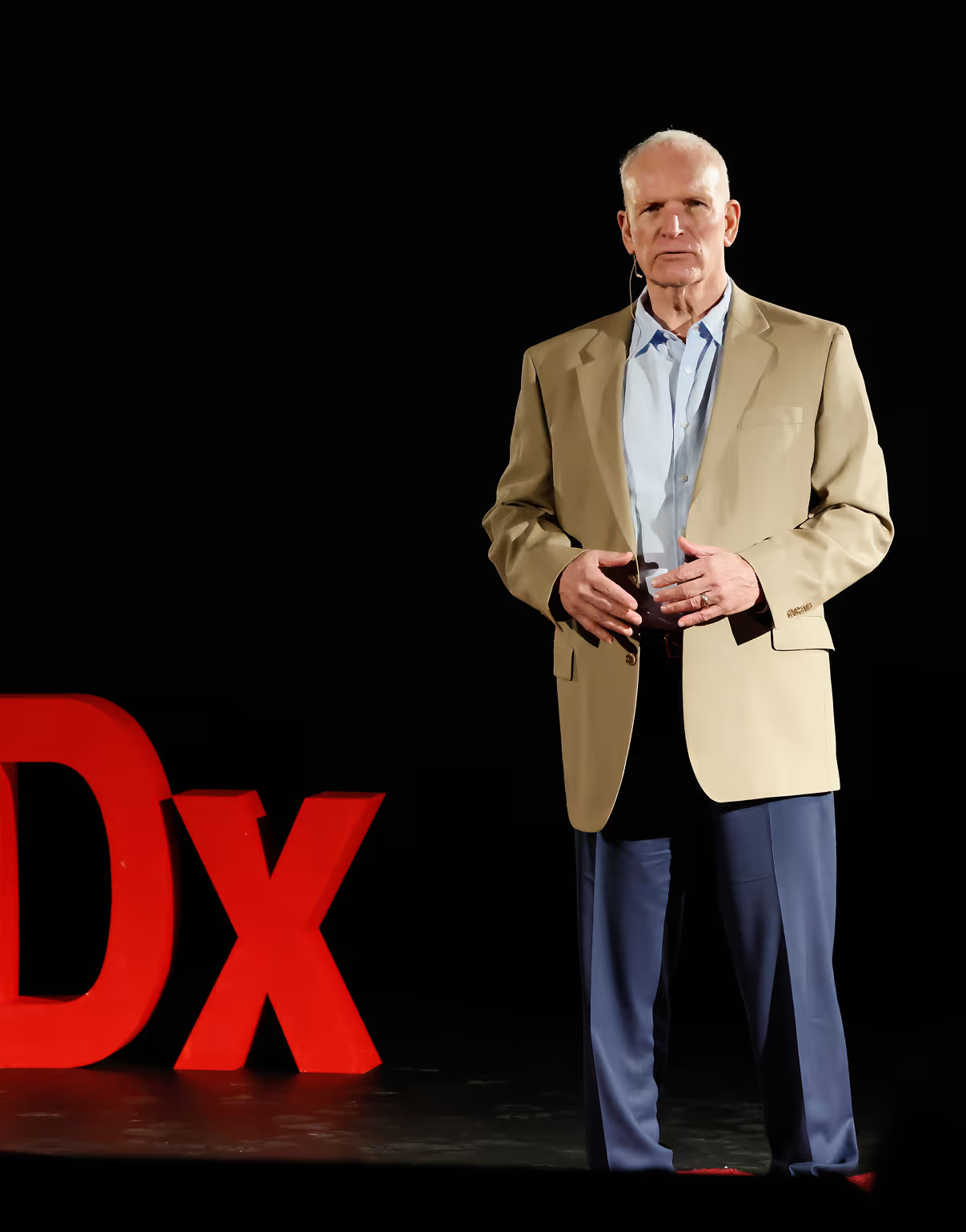
This is the neuroscience at the heart of Doug Noll's new book, Empathy Leadership: The Powerful Skill That Drives Winning Results
The four costs of performative leadership
1. The trust erosion effect
Employees trust consistency more than perfection.
When leaders appear overly managed or politically calculated, people stop believing what they hear.
Low trust environments require more meetings, more approvals, and more oversight.
Velocity drops.
If approval cycles slow a $12 million initiative by 45 days, deferred value can exceed $1.4 million.
2. The emotional suppression culture
Teams mirror leadership behavior.
If leaders hide stress, uncertainty, or mistakes, employees do the same.
Problems surface late.
Conflict stays hidden.
Burnout increases beneath artificial calm.
Suppression compounds operational risk.
3. The decision distortion pattern
Performative leaders optimize for appearance instead of clarity.
They avoid difficult truths that could threaten status.
The organization drifts into political communication.
Political communication slows decisions because people filter for optics before accuracy.
4. The exhaustion loop
Constant self monitoring drains cognitive energy.
The prefrontal cortex must work continuously to maintain the performance.
That creates fatigue.
Fatigued leaders become reactive, impatient, and emotionally inconsistent.
The mask eventually cracks under pressure.
The neuroscience of authenticity
The amygdala constantly evaluates whether leadership behavior feels stable and genuine.
Congruence lowers threat.
Incongruence increases vigilance.
When leaders communicate authentically:
- Cortisol decreases across the room.
- Trust increases.
- Psychological safety improves.
- Cognitive flexibility expands.
Authenticity is not emotional oversharing.
It is alignment between reality and communication.
The nervous system relaxes around people who stop performing.
The counterintuitive protocol
Stop managing perception first.
Regulate emotion first.
When pressure rises, do not pretend calm you do not feel.
Name reality accurately.
“This is creating pressure.”
Pause.
“I am concerned about the timeline.”
Pause.
“I handled that poorly.”
Pause.
Short, direct statements.
No emotional performance.
No motivational theater.
No fake certainty.
If someone reacts emotionally, regulate before solving.
“You seem frustrated.”
Pause.
“You are concerned this could fail.”
Pause.
Accurate emotional labeling reduces amygdala activation. Cortisol declines. The prefrontal cortex regains clarity.
Now the room can think again.
Authentic leadership is not emotional exposure for its own sake.
It is reducing the gap between reality and communication.
That gap determines trust.
If authentic leadership improves retention by just 2 senior employees at $350,000 replacement cost each and restores 5 percent productivity across a $20 million payroll, the value exceeds $1.7 million.
People do not follow polished performances under pressure.
They follow nervous systems that feel stable.
Stop performing.
Start regulating.
That is leadership.